
Fitness · Research · 4 min read
Drop-set training: similar muscle and strength gains, but harder sessions
A 2026 meta-analysis compared drop-set training with traditional resistance training. Long-term muscle and strength gains were about the same; drop sets felt much harder.
The short version
Drop-set training (DROP) means taking a set to failure, lowering the weight right away, and continuing without rest until failure again. A 2026 meta-analysis in Sports Medicine – Open pooled the trials that compared it with traditional resistance training (TRAD).
Over 6 to 12 weeks, the two methods gave about the same muscle growth and strength. In a single session, drop sets felt much harder (perceived exertion SMD 1.62, Results “Acute Responses”, Fig. 2A). The Results section also reports higher blood lactate (SMD 0.67, p = 0.006, Fig. 2B), but the main-text Conclusion says lactate “did not show statistically significant pooled differences,” while the Abstract’s conclusion calls the lactate response significantly higher.
“DROP is characterized by performing an exercise to momentary muscular failure, immediately reducing the load, and continuing without rest until failure is reached again […]”
Havers et al. · Introduction · full text
What the researchers did
The team searched the literature up to 20 January 2026 and analysed 16 studies. 12 of them, with 274 participants, went into the meta-analysis. Long-term results came from 16 comparisons in 9 studies, and single-session results from 8 comparisons in 4 trials.
Participants were healthy adults with average ages from about 19 to 36. Most studies used resistance-trained participants, and most included only men. Training programs lasted 6 to 12 weeks. Results are reported as standardized mean differences (SMD), where 0 means no difference.
Key findings
| Outcome | SMD | 95% CI | p | Location |
|---|---|---|---|---|
| Muscle hypertrophy (long term) | 0.04 | −0.29 to 0.36 | 0.813 | Fig. 4A |
| Muscular strength (long term) | −0.04 | −0.34 to 0.26 | 0.802 | Fig. 4B |
| Local muscle endurance (long term) | 0.53 | −0.20 to 1.26 | 0.153 | Fig. 4C |
| Perceived exertion, RPE (acute) | 1.62 | 0.33 to 2.91 | 0.014 | Fig. 2A |
| Blood lactate (acute) | 0.67 | 0.20 to 1.14 | 0.006 | Fig. 2B |
| Heart rate (acute) | 0.45 | −0.12 to 1.02 | 0.124 | Fig. 2C |
| Source: Havers et al. 2026, Abstract, Results, Fig. 2 and Fig. 4 · Full text (PMC) | ||||
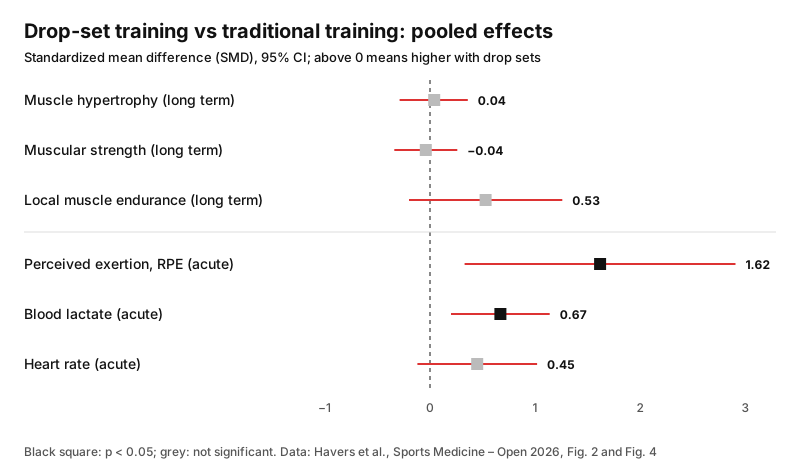
“Both training modalities lead to comparable long-term gains in muscle hypertrophy, strength, and muscle endurance.”
Havers et al. · Key Points · full text
“Drop-set training induces significantly higher perceived exertion, blood lactate concentrations, and neuromuscular fatigue than traditional resistance training.”
Havers et al. · Key Points · full text
How to read the result
For muscle and strength, the pooled differences sit almost exactly on zero. Removing any single study didn't change that.
The harder feel is the clearer result. Perceived exertion had the largest pooled difference, though the studies varied a lot (I² = 87.9%). One included study also found drop sets were rated as more unpleasant.
“Overall, DROP was perceived as significantly more unpleasant than TRAD (p < 0.001, d = 0.86).”
Havers et al. · Systematic Review Approach · full text
The authors' main-text conclusion is more careful than their results section about lactate and heart rate. It says the strongest pooled difference was for perceived exertion and that conclusions about extra physiological stress should be made with caution.
Limitations
The studies were small, about 21 people each on average, and their quality scores were modest (PEDro mean 4.8 out of 10). Most studies included only young men, and drop-set designs differed from study to study. “No difference” here isn't proof that the methods are identical.
“These small sample sizes can significantly reduce statistical power and increase the risk of type II errors when comparing DROP and TRAD.”
Havers et al. · Limitations · full text
How to apply it
If you're short on time, drop sets are one option for a shorter session; in these 6–12-week trials, muscle and strength gains were comparable (hypertrophy SMD 0.04, p = 0.813; strength SMD −0.04, p = 0.802; Results, Fig. 4). The time saving itself comes from earlier studies cited by the authors (Introduction, Sødal et al. [14]: “half to one-third of the training time”), not from this analysis.
If you already find training hard to stick with, traditional sets gave comparable results and were rated less hard (drop sets were rated harder: RPE SMD 1.62, Fig. 2A). Pick the one you'll keep doing.
Sources
- StudyHavers T, Micke F, Geisler S, Held S. Acute and Chronic Effects of Drop-Set Training: A Meta-Analysis and Systematic Review. Sports Medicine – Open. 2026;12:38.
DOI: 10.1186/s40798-026-01012-1 · Full text (PMC) · Publisher full text (CC BY 4.0)
This article explains research for education. It isn't medical advice.