
Fitness · Research · 2 min read
Muscle length and regional growth: small average contrasts
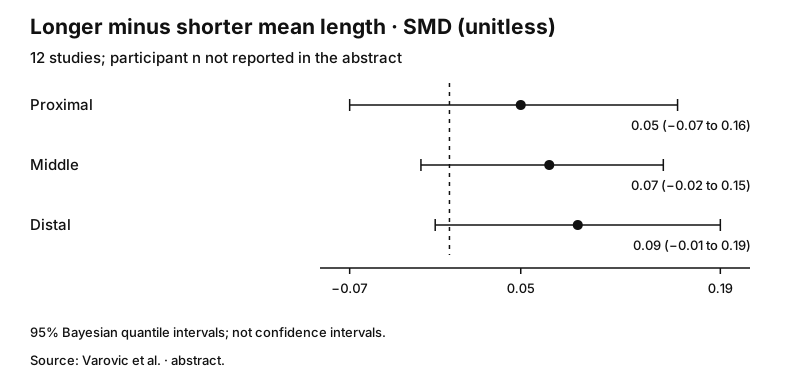
A Bayesian meta-analysis found small average regional differences between training at longer and shorter mean muscle lengths. Every reported interval included zero.
What the researchers did
The systematic review included 12 studies in young adults and examined proximal, middle and distal muscle regions. Total participant count, training-status breakdown and duration range were not reported in the abstract. The average muscle-length contrast was only 21.8%.
Key findings
| Region | SMD (unitless) | 95% QI (unitless) |
|---|---|---|
| Proximal | 0.05 | −0.07 to 0.16 |
| Middle | 0.07 | −0.02 to 0.15 |
| Distal | 0.09 | −0.01 to 0.19 |
| Source: Varovic et al. abstract · Study source | ||
“Our findings suggest that RT at both longer and shorter mean muscle lengths produces similar hypertrophic effects.”
Varovic et al. · abstract
How to read the result
The estimates are standardized mean differences, not percentage muscle growth. The intervals are Bayesian quantile intervals, not confidence intervals or SDs. The authors describe these as trivial effects estimated with relatively high precision, with a high share of the posterior distributions inside the region of practical equivalence at every site.
Limitations
The modest average length contrast limits what the analysis can say about very different training positions.
How to apply it
Avoid assuming that a longer muscle position will always produce more growth in every region. Use the result to keep expectations measured, while considering the actual exercise and range being compared.
Sources
- StudyVarovic D, Wolf M, Schoenfeld BJ, Steele J, Grgic J, Mikulic P. Does Muscle Length Influence Regional Hypertrophy? A Systematic Review and Meta-Analysis.
DOI: 10.1055/a-2615-4935 · PubMed abstract
This article explains research for educational use.