
Fitness · Research · 2 min read
Single-set training: failure edged ahead on some growth measures
In trained adults doing single-set workouts, both failure and repetitions-in-reserve training improved most outcomes. Some muscle-growth measures tended to favor failure, but the reported absolute differences were modest.
What the researchers did
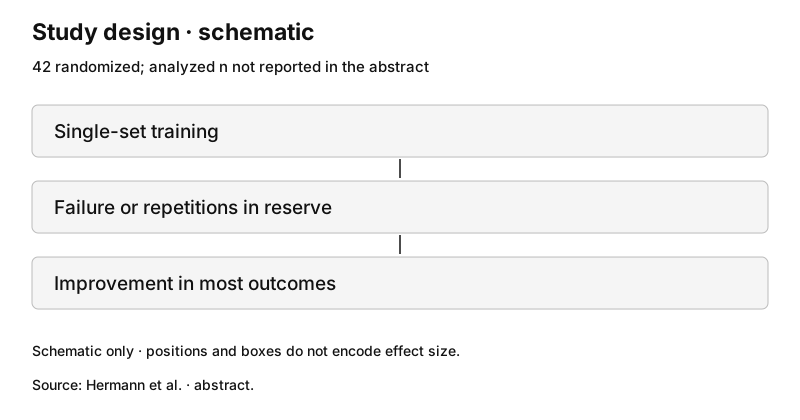
The parallel-group trial randomized 42 young resistance-trained men and women. It ran for eight weeks, twice weekly, with one set of nine exercises per session. The comparison was failure versus two repetitions in reserve. The final analyzed sample was not reported in the abstract.
Key findings
| Outcome | Reported result | Interpretation |
|---|---|---|
| Most outcomes | Improved | Both conditions |
| Some hypertrophy measures | Tended toward failure | Modest absolute differences |
| Between-group effect / interval | Not reported in the abstract | Omitted |
| Source: Hermann et al. abstract · Study source | ||
“Several measures of hypertrophy tended to favor FAIL, although absolute differences between conditions were generally modest.”
Hermann et al. · abstract
How to read the result
This is a useful comparison for a low-volume format: stopping short of failure still accompanied improvement. The tendency favoring failure should not be turned into a precise expected benefit, because numerical between-group hypertrophy effects and intervals were not reported in the abstract.
Limitations
The study tested single sets, so it does not establish the best reserve target for multiset training. Improvement in both groups does not establish that the effects were equivalent.
How to apply it
If your routine uses single sets, this study gives a reason to consider how close you finish to failure. Treat the possible advantage as modest and uncertain.
Sources
- StudyHermann T, Mohan AE, Enes A, Sapuppo M, Piñero A, Zamanzadeh A, Roberts M, Coleman M, Androulakis Korakakis P, Wolf M, Refalo M, Swinton PA, Schoenfeld BJ. Without Fail: Muscular Adaptations in Single-Set Resistance Training Performed to Failure or with Repetitions-in-Reserve.
DOI: 10.1249/MSS.0000000000003728 · PubMed abstract
This article explains research for educational use.