
Fitness · Research · 6 min read
Task specificity: the trained lift showed twice the strength effect of an isometric test
A 2025 meta-analysis of 43 studies found that dynamic resistance training raised strength in the trained exercise with a two-fold larger effect size than strength in a non-trained isometric test. Muscle hypertrophy and muscle activity changes did not significantly predict either gain.
The short version
Task specificity means you get bigger gains in the exercise you trained than in a non-trained test of the same muscles. A 2025 systematic review with meta-analysis in Sports Medicine measured that gap for traditional dynamic resistance training (RT) with free weights or training machines. The question: how much of the strength built in the trained lift shows up on a non-trained isometric strength test?
Pooled across 72 RT interventions, the within-group effect on dynamic strength was SMD 0.98 (95% CI 0.91–1.06). The effect on non-trained isometric strength was SMD 0.42 (95% CI 0.35–0.49). The authors call the first moderate and the second small (Results, Fig. 2).
“Our findings demonstrated task specificity of dynamic RT, as dynamic strength increased with a two-fold larger effect size than non-trained isometric muscle strength.”
Saeterbakken et al. · Abstract, Conclusions · full text
What the researchers did
The team searched MEDLINE (EBSCO), Web of Science, and Scopus, followed PRISMA, and registered the protocol in PROSPERO (CRD42023493208). Included trials used traditional dynamic RT with free weights or training machines. They ran at least ten sessions and lasted 5 weeks or more. Participants were healthy and aged 16–60. Each trial tested both dynamic and isometric strength of the trained muscles. Electrical stimulation, isokinetic, instability, (accentuated) eccentric, velocity-based, and blood-flow-restriction training were excluded.
Dynamic tests were repetition-maximum tests, such as 1RM, in the trained exercise. Typically, a squat, deadlift, or leg press was the dynamic test and a knee extension was the isometric test. Each effect is a within-group, pre-to-post standardized mean difference (SMD, Hedges’ g), pooled with a random-effects model. Sub-groups split the data by RT status, intervention length, single-joint vs multi-joint exercises, upper vs lower body, and position-matched tests. Meta-regressions checked whether changes in muscle hypertrophy or muscle activity predicted the strength effects.
Study quality on the Brughelli scale ranged from 14 to 20 out of 20 (median 17). The criterion missed most often was a control group.
Key findings
| Analysis | Dynamic strength (trained task) | Isometric strength (non-trained) | Location |
|---|---|---|---|
| All 72 interventions | 0.98 (95% CI 0.91–1.06; I² = 67%) | 0.42 (95% CI 0.35–0.49; I² = 4%) | Results, Fig. 2 |
| Sedentary participants | 1.27 | 0.58 | Discussion, Fig. 3 |
| Resistance-trained participants | 0.75 | 0.29 | Discussion, Fig. 3 |
| Multi-joint tested exercises | 1.02 | 0.33 | Discussion, Fig. 4 |
| Single-joint exercises | 1.30 | 0.70 | Discussion, Fig. 4 |
| Position-matched multi-joint | 0.83 | 0.34 | Discussion, Fig. 7 |
| Position-matched single-joint | 0.91 | 0.47 | Discussion, Fig. 7 |
| Range across all sub-groups | 0.75–1.30 | 0.29–0.70 | Results, Figs. 3–7 |
| Source: Saeterbakken et al. 2025, Abstract, Results (Meta-analyses) and Discussion · Full text (PMC) | |||
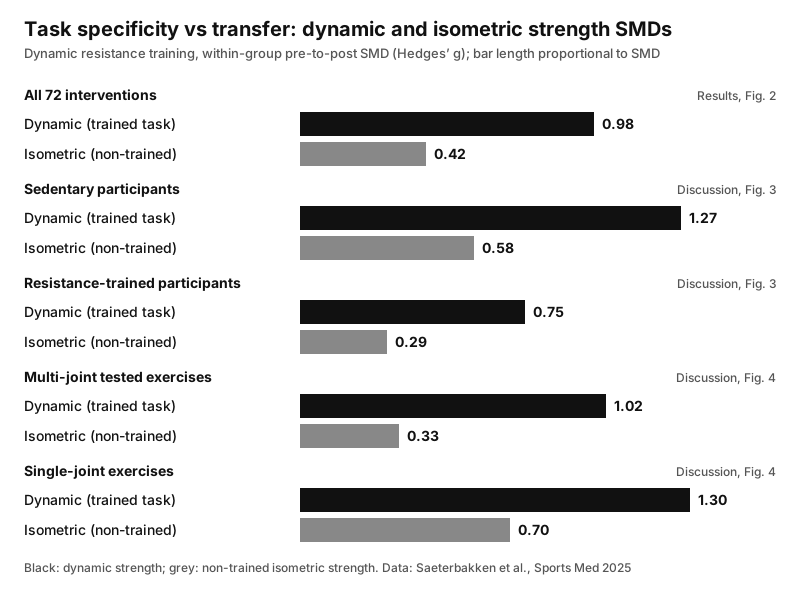
“Still, and irrespective of RT status, the task-specificity effects were more than twice as large as the transferability effects (SMD ratio dynamic: isometric of 2.2–2.6).”
Saeterbakken et al. · Discussion · full text
“Of the different moderators, sedentary subjects and single-joint exercises had the largest impact on task specificity.”
Saeterbakken et al. · Conclusions · full text
How to read the result
The authors grade SMDs as trivial below 0.2, small from 0.2 to 0.6, medium from 0.6 to 1.2, and large from 1.2 to 2.0. Every sub-group came out in the same order. Dynamic effects ran from 0.75 to 1.30. Isometric effects ran from 0.29 to 0.70.
Resistance-trained participants had the smallest effects (0.75 dynamic, 0.29 isometric). Sedentary participants had the largest (1.27 and 0.58). In both groups the trained-task effect was still more than twice the transfer effect.
Single-joint exercises showed the most transfer: isometric SMD 0.70, against 0.33 for multi-joint exercises. Many studies paired a multi-joint dynamic test, like a squat, with a single-joint isometric test, like a knee extension. So the authors also ran position-matched analyses. The gap stayed: 0.83 vs 0.34 for multi-joint tests and 0.91 vs 0.47 for single-joint tests.
“Muscle hypertrophy and activity changes did not significantly predict dynamic RT effects on dynamic and isometric muscle strength (p ≥ 0.222).”
Saeterbakken et al. · Abstract, Results · full text
Those models explained 0 to 13.4% of the variance between effect sizes (Table 2). The shared variance between the task-specific and transfer effects was trivial (r² = 0.08; Discussion). The authors read this as dynamic and isometric strength being different strength domains.
What this doesn’t tell us
The authors say none of the included papers was designed mainly to compare dynamic and isometric strength changes. Every effect is within-group, pre to post. There were no training-vs-control comparisons, and heterogeneity ran from low to high (I² = 0–79%).
“Importantly, of the 72 different RT interventions included, only one study examined a non-trained exercise in the dynamic testing procedures [74].”
Saeterbakken et al. · Discussion · full text
That means the review can’t separate two explanations: specificity of the contraction form (dynamic vs isometric) and specificity of the exercise itself (the movement pattern). It also didn’t compare free weights with machines.
Most interventions tested the lower body (65, against 8 for the upper body), so upper-body lifts are thinly covered. The hypertrophy and muscle-activity regressions rest on 13 and 9 studies. Most studies lasted 12 weeks or less, which the authors say may understate the role of hypertrophy. Six studies with effect sizes above 3 were flagged as presumed outliers; five were removed and one was kept. Participants were healthy adults aged 16–60, so older adults and clinical groups fall outside this evidence.
A few reporting slips show up on a close read. Sub-group intervention counts don’t all add up to 72 (8 upper-body plus 65 lower-body interventions makes 73). One Discussion sentence says hypertrophy and muscle activity changes “predicted” the effects, which conflicts with the Results and Table 2.
How to apply it
If you care about strength in one particular lift, this review found the largest gains in the trained task. A non-trained isometric test of the same muscles showed a smaller effect.
This is my opinion, not advice. If I were in your spot and wanted strength in a specific lift or movement, I would include that movement in the program, and I would expect gains measured on a different test to look smaller.
Sources
Source: Saeterbakken et al., Sports Med 2025; systematic review with meta-analysis of 43 studies. DOI 10.1007/s40279-025-02225-2.
- StudySaeterbakken AH, Stien N, Paulsen G, Behm DG, Andersen V, Solstad TEJ, Prieske O. Task Specificity of Dynamic Resistance Training and Its Transferability to Non-trained Isometric Muscle Strength: A Systematic Review with Meta-analysis. Sports Medicine. 2025;55(7):1651–1676.
DOI: 10.1007/s40279-025-02225-2 · Full text (PMC) · Publisher full text (CC BY 4.0)
This article explains research for education. It isn't medical advice.