
Fitness · Research · 4 min read
Training frequency: four short leg sessions gave more squat strength than one long one
A 2024 randomized trial split the same weekly leg training into one or four sessions. Four sessions gained about 7 kg more on the squat 1RM; muscle thickness grew similarly.
The short version
Training frequency means how many times a week you train a muscle group. A 2024 randomized trial in the European Journal of Sport Science kept the weekly leg workload the same and changed only how it was split.
One group did all four leg exercises in one session a week (LOW). The other did one exercise per session, four sessions a week (HIGH). After 8 weeks, HIGH gained about 7 kg more on the squat 1RM. Muscle thickness grew in both groups, with no clear difference between them.
What the researchers did
27 resistance-trained adults aged 18 to 30 started and 22 finished (15 women, 7 men). Everyone had trained weekly for at least 6 months. The program used four multi-joint exercises for the hip and knee extensors, 4–5 sets each, moving from 12-repetition maximum to 6-repetition maximum over 8 weeks.
Squat 1RM was tested on a Smith machine. Vastus lateralis thickness (a front-thigh muscle) was measured by ultrasound, and lower-body muscle mass by a bioelectrical impedance scale.
Key findings
| Outcome | LOW: once a week | HIGH: four times a week | Between-group p |
|---|---|---|---|
| Squat 1RM | +8 kg (3, 13) | +15 kg (10, 20) | 0.01 |
| Vastus lateralis thickness | +2.8 mm (1.2, 4.0) | +2.3 mm (0.9, 3.7) | 0.57 |
| Countermovement jump | +1.5 cm (0.3, 2.7) | +1.9 cm (0, 3.8) | 0.63 |
| Lower-body muscle mass (bioimpedance) | no significant increase | no significant increase | 0.26 |
| Source: Pedersen et al. 2024, Results section 3 and Table 2 · Full text (PMC) | |||
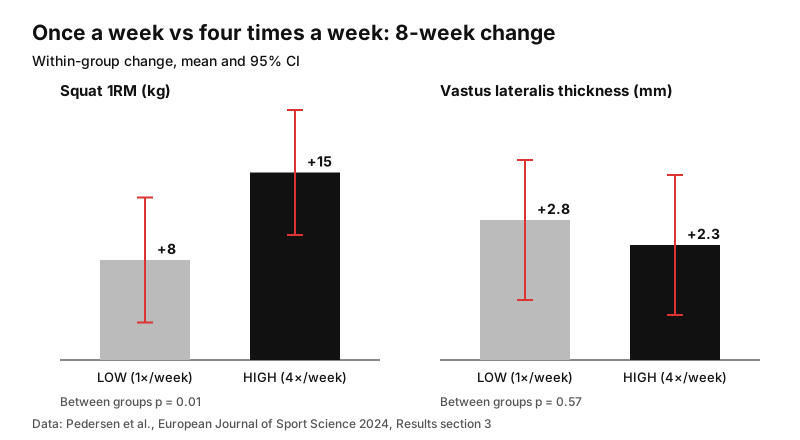
“The HIGH group demonstrated a statistically significant increase in 1‐RM compared to the LOW group (7 kg, p = 0.01) […]”
Pedersen et al. · Abstract · full text
“Both frequencies were similarly effective in improving muscle hypertrophy and jump height.”
Pedersen et al. · Abstract · full text
How to read the result
The strength gap is the clear result here. The muscle result is “no significant difference,” which isn't the same as “proven identical.” With 11 people per group, a small difference could be missed.
Workload wasn't perfectly equal in practice. HIGH lifted 62,559 kg in total and LOW 53,159 kg. That gap wasn't statistically significant (p = 0.18), but the authors note it was of medium size, and it may be part of why HIGH got stronger.
Table 2 lists the between-group squat difference as 7.1 kg with an interval of 0.0 to 12.6 kg, so the size of the edge is uncertain.
Limitations
The sample was small, young (mean age 21.6) and trained for only 8 weeks. Only one leg muscle was measured, at one spot. Diet wasn't controlled. The study compared one session with four, so it can't say whether two or three sessions would do just as well.
“However, muscle thickness was only measured in the vastus lateralis and only at the midpoint of the muscle.”
Pedersen et al. · Discussion · full text
How to apply it
If you train legs in one long weekly session and care most about squat strength, splitting the same sets over more days is a reasonable thing to try.
If muscle size is your main goal, this trial didn't find that the split mattered. Pick the schedule you can keep up week after week.
Sources
- StudyPedersen H, Iversen VM, Vereide PF, Stien N, Saeterbakken AH, Fimland MS, Schoenfeld BJ, Andersen V. High-frequency resistance training improves maximal lower-limb strength more than low frequency. European Journal of Sport Science. 2024;24(5):557–565.
DOI: 10.1002/ejsc.12055 · Full text (PMC) · Publisher full text (CC BY-NC-ND 4.0)
This article explains research for education. It isn't medical advice.