
Fitness · Research · 7 min read
Velocity loss in women's bench press: 50% brought the biggest 1RM gains
A 2026 training study in 49 resistance-trained women compared bench press sets stopped at 0%, 25%, or 50% velocity loss. The 50% group gained the most 1RM, but it also did far more repetitions.
The short version
Velocity-based training (VBT) tracks how fast the bar moves on every rep. Velocity loss (VL) is how much slower the last rep of a set is than the fastest one. The bigger the VL you allow, the closer the set gets to failure.
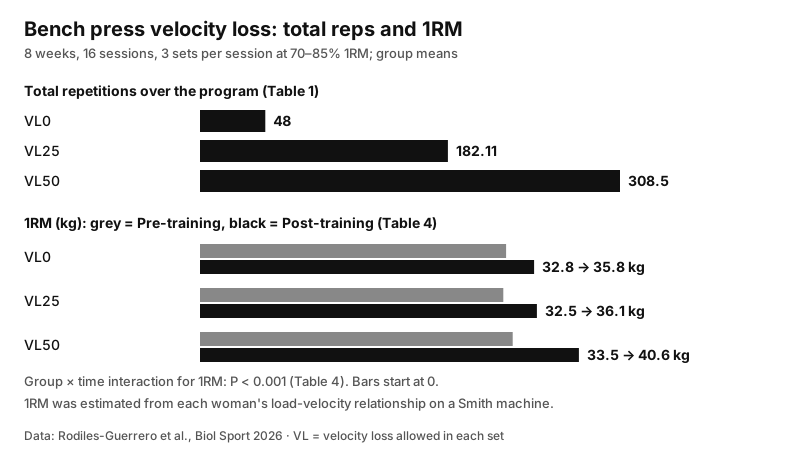
A 2026 study in Biology of Sport had resistance-trained women bench press with one of three VL thresholds: 0% (VL0, one repetition per set), 25% (VL25), or 50% (VL50). All three groups got stronger. 1RM went from 32.8 to 35.8 kg in VL0, from 32.5 to 36.1 kg in VL25, and from 33.5 to 40.6 kg in VL50. The group × time interaction for 1RM was significant (P < 0.001; Table 4).
The catch is volume. Across the program, VL50 did 308.5 repetitions on average and VL0 did 48 (Table 1). So the study can't say whether the threshold itself or all that extra work made the difference.
“The difference between groups was the VL allowed in each training set.”
Rodiles-Guerrero et al. · Materials and Methods · full text
What the researchers did
57 women volunteered. Each had at least one year of systematic resistance training that included the bench press (BP). 49 finished: VL0 n = 17, VL25 n = 18, VL50 n = 14. Mean age was 21.4 ± 2.9 years, and the paper rates their BP relative strength as intermediate. Participants were allocated to groups based on their 1RM.
Everyone did the BP on a Smith machine twice a week for 8 weeks, 16 sessions in all. Each session had 3 sets with 4 minutes of inter-set recovery, and the load climbed from 70% to 85% 1RM. A linear velocity transducer recorded every rep. VL0 did one rep per set. The other two groups kept going until bar speed had dropped by 25% or 50%. The authors put VL25 at 40–50% of the possible repetitions per set and VL50 at 75–85%.
Before and after the program, the team measured triceps brachii (TB) lateral head thickness with ultrasound, maximal isometric force (MIF) and rate of force development (RFD), and a progressive loading test. 1RM was estimated as the load lifted at 0.17 m·s−1 on each woman's load-velocity relationship. A fatigue test counted the maximal number of repetitions (MNR) to failure with the load that was 70% 1RM at Pre-training.
Key findings
| Outcome | VL0 | VL25 | VL50 | Group × time P | Location |
|---|---|---|---|---|---|
| Mean VL reached (%) | 0 | 26.0 ± 1.8 | 50.8 ± 1.9 | – | Table 1 |
| Average reps per set | 1 | 3.8 ± 0.6 | 6.4 ± 1.2 | – | Table 1 |
| Total repetitions | 48 | 182.11 ± 31.42 | 308.5 ± 59.48 | – | Table 1 |
| 1RM (kg) | 32.8 → 35.8 (0.38) | 32.5 → 36.1 (0.45) | 33.5 → 40.6 (0.88) | < 0.001 | Table 4 |
| MNR in fatigue test (reps) | 11.8 → 16.7 (1.25) | 13.2 → 18.4 (1.36) | 12.7 → 20.9 (2.08) | 0.08 | Table 4 |
| MIF (N) | 424.3 → 460.1 (0.41) | 387.7 → 445.2 (0.66) | 419.6 → 467.0 (0.54) | 0.63 | Table 3 |
| RFDmax (N·s−1) | 2512.3 → 3039.9 (0.43) | 2372.8 → 3023.4 (0.53) | 2622.4 → 2819.3 (0.16) | 0.58 | Table 3 |
| TB thickness, within group | Not significant | Not significant | Significant (P = 0.01) | Not significant | Results, Fig. 1B |
| Source: Rodiles-Guerrero et al. 2026, Tables 1, 3 and 4, Results and Fig. 1B; values are mean ± SD or Pre → Post means · Full text (PMC) | |||||
How to read the result
Muscle size is the weakest part of the headline. Only VL50 showed a significant increase in TB thickness within its own group (P = 0.01, Fig. 1B). The interaction between groups wasn't significant. On top of that, 12 participants were left out of the ultrasound analysis because of excessive subcutaneous fat, so that analysis had N = 37.
“No significant group × time interaction was noted for the muscle thickness, while a significant overall time effect was reported (P = 0.048).”
Rodiles-Guerrero et al. · Results · full text
The middle threshold had a result of its own. All three groups raised MIF. Only VL25 showed significant within-group gains in RFDmax (P = 0.04), RFD0–100 (P = 0.05), and RFD0–200 (P = 0.03). None of the force-time variables had a significant group × time interaction (Table 3).
“Intriguingly, although all groups improved their MIF, only the VL25 intervention enhanced the ability to produce force quickly (i.e., RFDmax, RFD0–100, and RFD0–200).”
Rodiles-Guerrero et al. · Discussion · full text
One rep per set still did something. VL0 did 48 reps across the whole program, and its 1RM still went up.
“Performing only one repetition per set was enough to improve strength in intermediate-trained women but was insufficient to maximize strength gains.”
Rodiles-Guerrero et al. · Abstract · full text
The authors also give a reason women might need a higher threshold than men. Earlier work they cite found that at a given VL threshold, women completed a lower percentage of their possible repetitions than men.
“This suggests that the same VL percentage corresponds to a lower relative effort in women, potentially necessitating higher VL thresholds to elicit comparable training stimuli and adaptations.”
Rodiles-Guerrero et al. · Discussion · full text
What this doesn't tell us
Volume wasn't matched. VL50 did 308.5 total reps and VL0 did 48, and VL50 reached muscle failure in 4 sets (VL25 in 1). The effect of the threshold can't be pulled apart from the effect of more reps and sets taken closer to failure. The authors themselves link the extra repetitions to the hypertrophy result.
Group assignment is described two ways. The abstract says the women were “randomly assigned,” but the Methods say they were “allocated based on their 1RM” into the three training groups. The paper doesn't describe a randomization procedure.
The hypertrophy finding is within-group only, at one site on the triceps lateral head. Pectoralis major thickness wasn't measured. The groups were small, and VL50 lost the most people (19 to 14). The MNR difference between groups wasn't significant (P = 0.08).
1RM was estimated from the load-velocity relationship on a Smith machine, not tested directly with free weights. The program covered one exercise, two sessions a week, 8 weeks, in young intermediate-trained women who, as the authors note, “were not athletes.” The Table 3 and 4 footnotes say N = 46, while the group sizes add up to 49. Using this method also takes a device that measures bar velocity on every rep.
How to apply it
If your goal is a heavier bench press single and you already train with a velocity device, this study is one data point for letting sets run to a higher VL. If producing force quickly matters more to you, VL25 was the only group with significant RFD gains here. If you're short on time, one rep per set still raised 1RM, just less.
This is my opinion, not advice. If I were in your spot and chasing a heavier single, I would let bench press sets run longer before stopping them, and I'd keep in mind that this study can't separate the threshold from the extra reps.
Sources
Source: Rodiles-Guerrero et al., Biol Sport 2026; 8-week program. DOI 10.5114/biolsport.2026.152347.
- StudyRodiles-Guerrero L, Cano-Castillo C, Cornejo-Daza PJ, Sánchez-Valdepeñas J, Sañudo B, Sánchez-Moreno M, Bachero-Mena B, Pareja-Blanco F. Effects of different velocity loss thresholds on strength, neuromuscular adaptations, and muscle hypertrophy during bench press training in women. Biology of Sport. 2026;43:187–198.
DOI: 10.5114/biolsport.2026.152347 · Full text (PMC, CC BY 4.0)
This article explains research for education. It isn't medical advice.