Picture two people on the same lifting program for a few months. Same workouts, same weeks. One takes creatine every day. The other takes a placebo.
In a 2022 meta-analysis of 35 randomized controlled trials (1,192 participants), creatine added 0.68 kg of lean body mass overall (95% CI 0.26 to 1.11 kg). In the trials that paired it with resistance training, the creatine groups gained 1.10 kg more lean body mass than placebo (95% CI 0.56 to 1.65 kg). That 1.10 kg is about 2.4 pounds of extra lean mass from one cheap powder (Delpino et al., 2022, Nutrition).
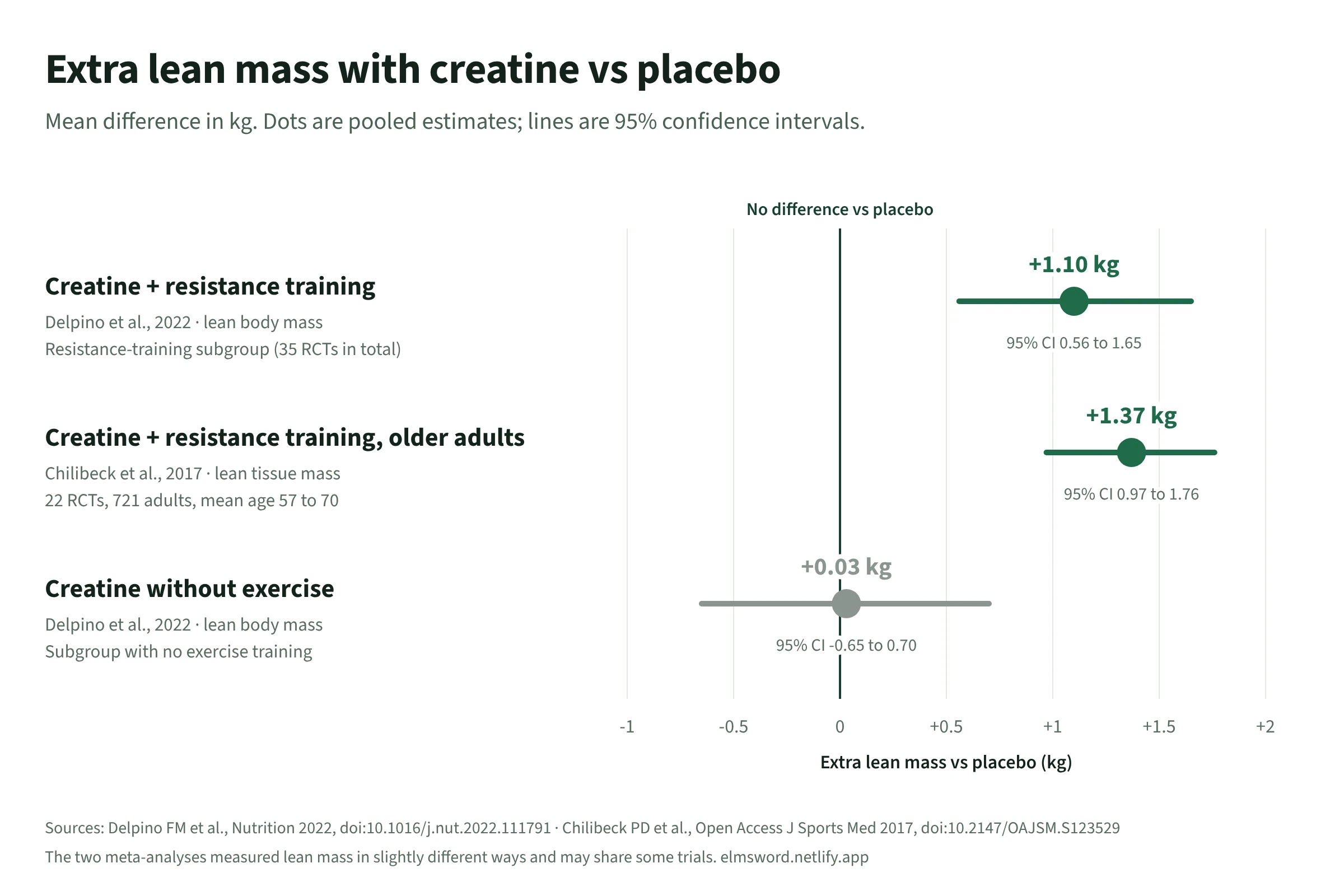
It holds up past middle age, too (the two reviews may share trials). A 2017 meta-analysis pooled 22 trials with 721 older adults (average age 57 to 70 across studies) who did resistance training 2 to 3 days a week for 7 to 52 weeks. The creatine groups gained 1.37 kg more lean tissue mass than placebo, and got stronger on both chest press and leg press (Chilibeck et al., 2017, Open Access Journal of Sports Medicine).
Strength goes up as well. Across 53 randomized placebo-controlled trials, creatine improved upper limb strength (global effect size 0.317). Across 60 trials, it improved lower limb strength (global effect size 0.235). Both papers found the effect held regardless of age, sex, training protocol, dose, or duration for exercises lasting under 3 minutes (Lanhers et al., 2017 and 2015, Sports Medicine).
Those effect sizes are small. They also held up across the 53 and 60 trials in those two papers, and they come from one of the most studied supplements there is. The 2017 position stand from the International Society of Sports Nutrition (ISSN) counts more than 1,000 studies on creatine since the early 1990s.
The key studies at a glance
| Study | What it pooled | What creatine added vs placebo |
|---|---|---|
| Delpino et al., 2022, Nutrition, doi:10.1016/j.nut.2022.111791 | 35 RCTs, 1,192 participants | Overall +0.68 kg (95% CI 0.26 to 1.11). +1.10 kg lean body mass with resistance training (95% CI 0.56 to 1.65). Without exercise: +0.03 kg, not significant |
| Chilibeck et al., 2017, Open Access J Sports Med, doi:10.2147/OAJSM.S123529 | 22 RCTs, 721 older adults, mean age 57 to 70 | +1.37 kg lean tissue mass (95% CI 0.97 to 1.76); chest press SMD 0.35; leg press SMD 0.24 |
| Lanhers et al., 2017, Sports Medicine, doi:10.1007/s40279-016-0571-4 | 53 RCTs, 1,138 people | Upper limb strength, effect size 0.317 (95% CI 0.185 to 0.449) |
| Lanhers et al., 2015, Sports Medicine, doi:10.1007/s40279-015-0337-4 | 60 RCTs, 1,297 people | Lower limb strength, effect size 0.235 (95% CI 0.125 to 0.346) |
| Xu et al., 2024, Frontiers in Nutrition, doi:10.3389/fnut.2024.1424972 | 16 RCTs, 492 participants | Memory SMD 0.31 (moderate certainty). No significant effect on overall cognitive function or executive function |
SMD means standardized mean difference. By the benchmarks Cohen proposed, an effect size of 0.2 is small and 0.5 is medium (as summarized by Sullivan and Feinn, 2012, Journal of Graduate Medical Education).
Why it works
Your muscles run on ATP (adenosine triphosphate). When ATP breaks down to release energy, phosphocreatine (PCr) steps in. Breaking down phosphocreatine releases energy the muscle uses to rebuild ATP. The ISSN position stand says this helps keep ATP available, especially during maximal effort sprint-type exercise.
About 95% of the body's creatine sits in skeletal muscle, and about two thirds of that is stored as phosphocreatine. A normal diet supplies 1 to 2 g of creatine a day, which leaves muscle creatine stores about 60 to 80% saturated. Supplementing raises muscle creatine and phosphocreatine by 20 to 40%, according to the ISSN.
With more creatine and phosphocreatine stored, muscles have more on hand for high-intensity work. The ISSN says this may help explain why creatine improves high-intensity exercise performance, which leads to greater training adaptations. That's why creatine pays off when you pair it with training. In the Delpino meta-analysis, creatine without exercise added just 0.03 kg of lean body mass, which wasn't significant. The powder alone doesn't build muscle. It helps the training you already do build more.
Who gets the most out of it
People who do resistance training. That's where the lean mass and strength numbers above come from.
Older adults who lift. In the Chilibeck meta-analysis, average ages ran from 57 to 70, and creatine added both lean tissue mass and strength. The authors open with the reason that matters: losing muscle mass and strength with aging leads to significant functional impairment.
Vegetarians. The ISSN notes that vegetarians have lower muscle creatine stores (90 to 110 mmol/kg of dry muscle) and may see bigger gains in muscle creatine content when they supplement. Red meat and seafood are the main food sources.
How to start
Pick creatine monohydrate. It's the form used in the early studies that worked out dosing and absorption, and it has been the most studied form since the early 1990s (Antonio et al., 2021, Journal of the International Society of Sports Nutrition).
You have two options:
- Steady route: 3 to 5 g a day. In Hultman et al. (1996, Journal of Applied Physiology), 3 g a day for 28 days raised muscle creatine by about 20%. That's the same rise as 20 g a day for 6 days, just slower. A 2021 review in the ISSN's journal (Antonio et al.) recommends about 3 to 5 g a day for at least 4 weeks to reach similar saturation.
- Fast route (loading): 5 g four times a day (about 0.3 g per kg of body weight a day) for 5 to 7 days, then 3 to 5 g a day to maintain. Loading isn't required. It just fills your muscles faster.
Some studies suggest larger athletes may need 5 to 10 g a day to maintain their stores, the ISSN notes.
What about safety?
Kidneys. A 2021 review in the ISSN's journal (Antonio et al.) concludes that healthy people taking recommended doses show no adverse effects on kidney function. A 2019 meta-analysis that pooled 6 trials concluded that creatine supplementation did not cause kidney damage at the amounts and durations studied. Its own numbers, though, show statistically significant differences between groups in serum creatinine and urea, so treat it as limited support (de Souza e Silva et al., 2019, Journal of Renal Nutrition). One catch: creatine can raise creatinine in blood and urine tests. Creatinine is a common kidney marker, so that rise doesn't necessarily mean your kidneys are struggling. The 2021 review warns that blood creatinine and estimated kidney-filtration results need caution in people who take creatine. Our suggestion: mention your creatine use before blood work. The 2017 ISSN position stand also notes that some have suggested people with pre-existing kidney disease consult their physician before starting creatine, as a precaution. The kidney case reports that worried people involved pre-existing kidney disease, medications, other supplements, or very high doses.
Weight gain. That's the only side effect the ISSN says has been consistently reported. Loading can cause short-term water retention of about 0.5 to 1.0 L in the first days. Several training studies lasting 5 to 10 weeks found no increase in total body water.
Hair loss. This worry traces back to one study of rugby players in which DHT went up. Those results haven't been replicated (Antonio et al., 2021).
Long-term use. The ISSN reports studies at 0.3 to 0.8 g per kg a day for up to 5 years in healthy and clinical populations with no adverse health risks.
The honest limits
The effect sizes for strength are small, around 0.2 to 0.3. Creatine won't turn a weak program into a great one.
Women in the trials gained less. In the Delpino meta-analysis, men on creatine gained 1.46 kg of lean body mass (95% CI 0.47 to 2.46), while women gained 0.29 kg (95% CI −0.43 to 1.01), which wasn't statistically significant.
It doesn't help endurance sports much. A 2003 meta-analysis of 100 studies found creatine doesn't appear to improve running or swimming performance (Branch, 2003, International Journal of Sport Nutrition and Exercise Metabolism). Effects on tasks lasting longer than 150 seconds were small (effect size 0.20).
The brain data is promising but thin. The 2024 meta-analysis rated the memory result as moderate certainty and the evidence for processing speed, attention, and overall cognitive function as low certainty. A 2018 review of six studies found creatine may improve short-term memory and intelligence/reasoning, while results in other areas conflicted and performance didn't change in young people (Avgerinos et al., 2018, Experimental Gerontology).
Several authors of the two ISSN papers disclose ties to companies that make or sell creatine. The two strength meta-analyses by Lanhers and colleagues came from a separate team based in Clermont-Ferrand, France, and they point the same way. Their reviews may share some trials with the others, and we didn't check their funding disclosures.
The bottom line
If you lift, including if you're over 50, creatine monohydrate is one of the few supplements with dozens of placebo-controlled trials behind it. You'd take 3 to 5 g a day, keep training, and give it at least 4 weeks to fill your muscles. On average, that adds about a kilo of lean mass and a small but real bump in strength on top of what your training gives you. Without training, the 35-trial meta-analysis found almost no gain in lean body mass.
READY TO COMPARE?
Three creatine monohydrate powders, side by side.
See how Nutricost, Optimum Nutrition, and Thorne compare on serving count, cost per serving, and certification. The comparison includes the exact Amazon links.
Compare the three creatine options →Buying links are paid links. We have compared specifications, not personally tested these products.